

The Statue of Liberty stands 305 feet 1 inch from the ground to the tip of the torch, weighs approximately 225 tons, and has 354 steps from the base to the crown. She was a gift from France to the United States, dedicated on October 28, 1886, and became a symbol of freedom and democracy recognised worldwide. The copper exterior — originally a shiny orange-brown — turned its characteristic green patina over approximately 20–30 years of oxidation.
The Statue of Liberty is one of the most recognised structures in the world, yet many of the facts that make it remarkable remain unknown to most visitors. This guide covers the full story — the diplomatic origins, the engineering challenges, the symbolism, and the numbers — along with a set of facts that consistently surprise even those who have visited multiple times.
Top Tickets
# Statue of Liberty Ticket
# Statue of Liberty & Ellis Island Tour
# Circle Line 2h Harbor Lights Cruise
Table of Contents
Quick Facts
| Fact | Detail |
|---|---|
| Official name | Liberty Enlightening the World (La Liberté éclairant le monde) |
| Dedicated | October 28, 1886 |
| Height (ground to torch tip) | 305 ft 1 in (93.0 m) |
| Height of statue only (base to torch) | 151 ft 1 in (46.0 m) |
| Weight of copper exterior | 62,000 lbs (28 tonnes) |
| Total weight | 450,000 lbs (204 tonnes) |
| Thickness of copper skin | 2.4 mm — about the thickness of two pennies stacked |
| Steps to the crown | 354 |
| Steps to the pedestal | 154 |
| Crown windows | 25 |
| Points on the crown | 7 (representing the seven seas and seven continents) |
| Original colour | Shiny copper-brown — turned green over 20–30 years |
| Sculptor | Frédéric Auguste Bartholdi |
| Internal engineer | Alexandre Gustave Eiffel |
| Architect of pedestal | Richard Morris Hunt |
| Island size | Approximately 12 acres |
| Designated National Monument | October 15, 1924 |
| UNESCO World Heritage Site | 1984 |
Origin: A Gift from France

The idea for the Statue of Liberty originated in 1865 at a dinner party in Versailles, where French political thinker Édouard de Laboulaye proposed that France should give the United States a monument to celebrate the ideals of liberty and democracy they shared. The American Civil War had just ended, and Laboulaye saw the monument as a celebration of the Union’s preservation of democratic values.
The project was conceived as a collaborative endeavour: France would build and fund the statue itself, while the United States would provide and fund the pedestal. French sculptor Frédéric Auguste Bartholdi was selected to design the monument, and in 1871 he sailed to America to scout the location — choosing Bedloe’s Island (now Liberty Island) in New York Harbour as the site.
Construction Timeline
| Year | Event |
|---|---|
| 1865 | Édouard de Laboulaye first proposes the gift at a dinner in Versailles |
| 1871 | Bartholdi visits the United States and selects Bedloe’s Island as the site |
| 1875 | French-American Union formed; fundraising begins in both countries |
| 1876 | The torch and hand are displayed at the Philadelphia Centennial Exposition |
| 1878 | The head is displayed at the Paris World’s Fair |
| 1881 | Alexandre Gustave Eiffel takes over the internal structural engineering |
| 1884 | The statue is completed in France and formally presented to the US ambassador |
| 1885 | The statue is disassembled into 350 pieces and shipped to New York |
| 1886 | Reassembly completed; statue dedicated on October 28 by President Grover Cleveland |
| 1916 | Torch closed to visitors after Black Tom Island explosion damages the arm |
| 1924 | Designated a National Monument |
| 1984 | Listed as a UNESCO World Heritage Site |
| 1986 | Major centennial restoration completed; new torch installed |
| 2012 | Closed after Hurricane Sandy; reopened July 4, 2013 |
| 2019 | New Statue of Liberty Museum opens on Liberty Island |
Gustave Eiffel’s Role
The Statue of Liberty would not stand today without Gustave Eiffel — the same engineer who later designed the Eiffel Tower in Paris. When the original structural engineer Eugène-Emmanuel Viollet-le-Duc died in 1879, Eiffel was brought in to solve the fundamental engineering challenge: how to keep a 151-foot copper statue upright through harbour winds without making it rigid.
Eiffel’s solution was revolutionary. Instead of a solid frame, he designed a flexible internal skeleton — a central iron pylon with a secondary framework connected by a system of flexible iron bars. The copper exterior is not bolted rigidly to this frame but hung from it, allowing the statue to flex in high winds rather than resist them. The structure can sway up to 3 inches in strong winds without any structural stress. This same flexible-skeleton principle informed Eiffel’s subsequent work on the Eiffel Tower.
What the Statue Symbolises
Every element of the statue’s design is intentional. Bartholdi conceived Lady Liberty as a figure of democracy, enlightenment, and the enduring friendship between France and the United States.
- The torch: raised in the right hand, it represents enlightenment — the light of freedom illuminating the world. The original torch was replaced in 1986; the original is now on display in the Statue of Liberty Museum
- The tablet: held in the left hand, it bears the date July 4, 1776 (JULY IV MDCCLXXVI) in Roman numerals — the date of American independence
- The crown with seven rays: the seven rays represent the seven seas and seven continents of the world — liberty radiating globally, not just to one nation
- The broken chains: at her feet, barely visible except on aerial views, lie broken chains and shackles — a symbol of freedom from oppression. These were added by Bartholdi as a specific reference to the abolition of slavery following the American Civil War
- The robes: Bartholdi modelled Lady Liberty’s robes on those of Libertas, the Roman goddess of freedom
Key Measurements
| Part of the Statue | Measurement |
|---|---|
| Index finger length | 8 ft (2.4 m) |
| Nose length | 4 ft 6 in (1.4 m) |
| Mouth width | 3 ft (0.9 m) |
| Head from chin to crown | 17 ft 3 in (5.3 m) |
| Hand length | 16 ft 5 in (5.0 m) |
| Waist circumference | 35 ft (10.7 m) |
| Sandal length | 25 ft (7.6 m) — equivalent to a size 879 shoe |
| Torch height above ground | 305 ft 1 in (93.0 m) |
The Copper Exterior: Colour Change Over Time
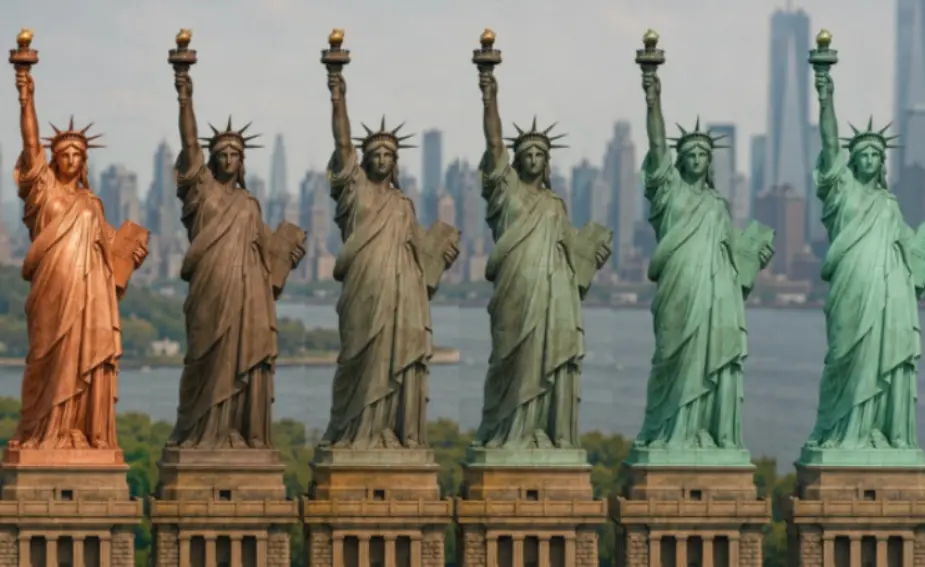
When the statue was unveiled on October 28, 1886, the copper exterior was the same shiny orange-brown colour as a new copper penny. Over the following 20–30 years, oxidation and the harbour air caused the copper to turn its now-iconic green patina — a process called verdigris. The patina is not paint or coating but the natural chemical reaction of copper with oxygen, water, and atmospheric carbon dioxide.
The National Park Service has never painted or artificially coloured the statue. The green exterior is entirely natural and acts as a protective layer that prevents further corrosion of the copper beneath.
Ten Facts That Surprise Most Visitors
- The Statue of Liberty was the tallest iron structure in the world when it was completed in 1886 — taller than the Washington Monument at the time
- The torch has been closed to visitors since 1916, when an explosion at the nearby Black Tom munitions depot damaged the arm and torch structure. No visitor has legally entered the torch since
- The original torch, replaced in 1986, is displayed in the Statue of Liberty Museum on Liberty Island — it is the single most remarkable object on the island
- The face of Lady Liberty is widely believed to be modelled on Bartholdi’s mother, Charlotte Bartholdi — a claim Bartholdi never confirmed or denied
- Gustave Eiffel’s internal iron framework for the statue was designed four years before he built the Eiffel Tower, and uses a similar flexible-skeleton principle
- The statue’s copper skin is only 2.4 mm thick — approximately the thickness of two pennies stacked — despite the figure standing 151 feet tall
- There are 25 windows in the crown, one for each of the 25 rays. Each window is approximately 18 inches wide
- The island the statue stands on — Liberty Island — is officially part of the state of New Jersey, despite being visually associated with New York. The New Jersey Supreme Court confirmed this in 1998
- The statue has been struck by lightning more than 600 times per year on average, which is safely conducted through Eiffel’s iron framework to the ground
- The 1986 centennial restoration cost approximately $87 million — one of the largest historic preservation projects ever undertaken in the United States
Frequently Asked Questions
How tall is the Statue of Liberty?
The Statue of Liberty stands 305 feet 1 inch (93.0 metres) from the ground to the tip of the torch. The statue itself — from the base of the pedestal to the torch — is 151 feet 1 inch (46.0 metres).
When was the Statue of Liberty built?
The statue was built in France between 1875 and 1884, shipped to New York in 1885, reassembled on Bedloe’s Island, and officially dedicated on October 28, 1886 by President Grover Cleveland.
Who gave the Statue of Liberty to the United States?
France gave the Statue of Liberty to the United States as a symbol of shared democratic values and the friendship between the two nations. The project was initiated by French political thinker Édouard de Laboulaye in 1865 and funded by public donations in both countries.
Who designed the Statue of Liberty?
The statue was designed by French sculptor Frédéric Auguste Bartholdi. The internal iron structural framework was engineered by Alexandre Gustave Eiffel. The pedestal was designed by American architect Richard Morris Hunt.
Why is the Statue of Liberty green?
The copper exterior reacted with oxygen, water, and atmospheric carbon dioxide over 20–30 years after the statue’s 1886 dedication, turning from its original copper-brown colour to the green patina (verdigris) visible today. The colour is entirely natural.
How many steps are there in the Statue of Liberty?
There are 354 steps from the ground floor of the statue to the crown, and 154 steps to the pedestal observation deck. An elevator serves the pedestal for visitors who cannot manage the stairs.
What does the Statue of Liberty hold?
In her right hand she holds a torch raised high, representing enlightenment. In her left hand she holds a tablet inscribed with the date July 4, 1776 (in Roman numerals) — the date of American independence.
What are the seven points on the Statue of Liberty’s crown?
The seven rays of the crown represent the seven seas and seven continents of the world, symbolising liberty radiating universally rather than only to one nation.
Why is the torch closed to visitors?
The torch has been closed since 1916, when an explosion at the Black Tom munitions depot in New Jersey damaged the arm and torch structure. The original torch was replaced in 1986 and is now on display in the Statue of Liberty Museum.
What state is the Statue of Liberty in?
Liberty Island is officially within the jurisdiction of the state of New Jersey, as confirmed by the New Jersey Supreme Court in 1998, though the ferry departs from Manhattan in New York. For administrative purposes, the Statue of Liberty National Monument is managed by the National Park Service.
How heavy is the Statue of Liberty?
The total weight of the Statue of Liberty is approximately 450,000 pounds (204 tonnes). The copper exterior alone weighs approximately 62,000 pounds (28 tonnes). The copper skin is only 2.4 mm thick.
What is inside the Statue of Liberty?
Inside the statue, a narrow double-helix spiral staircase leads to the crown. Gustave Eiffel’s iron framework is visible throughout the interior climb. The Statue of Liberty Museum on Liberty Island houses the original 1886 torch, engineering exhibits, and a 100-seat immersive theatre.
